TL;DR
- On November 10 the IAB, the online ad industry's trade body, published The Creator Economy's Next Chapter. The standard most requested by the 53 industry leaders it surveyed, chosen by two-thirds of them, was a common definition of a "view." No brand or talent-side respondent said they were very confident in the numbers they receive.
- The push lands less than three months after YouTube started counting a public view from the very first frame of a video. Data from Agentio, a firm that buys creator sponsorships, found that on the videos it tracks, only about 6 in 10 of those public views were also engaged views, the number YouTube still uses to pay creators.
- The coverage frames this as a consistency problem. The bigger story is that the biggest video platform already knows which number it trusts, and it is not the one on the public counter. For Instagram creators, whose Reels views already count from the start of play, the safest move is to start selling attention now, before a standard does it for them.
In the first stretch after August 24, the YouTube videos tracked by Agentio, a company that buys creator sponsorships on behalf of brands, collected 549 million public views. YouTube's own analytics, looking at the same videos, recorded 330 million engaged views. Both figures came from YouTube. Both were called views. The gap between them, roughly 219 million, needed no fraud and no glitch to exist. It came from a definition.
August 24 was the day YouTube changed that definition. From then on, a public view on any video counted the moment it began to play, from the first frame, with no minimum watch time. Before the change, a long-form view required some amount of watching that YouTube never published (the industry widely assumed it was about 30 seconds). Shorts had already moved to the first-frame rule in 2025. YouTube said the switch would give creators a clearer picture of their overall exposure when they talk to brand partners. It also said that creator earnings would continue to be based on engaged views and engaged watch hours.
Eleven weeks later, the ad industry's trade body put the distrust on paper. On November 10 the Interactive Advertising Bureau released The Creator Economy's Next Chapter, the first report from a new Trusted Creator Brand Deal Initiative. Out of 11 possible standards, the one respondents wanted most, at 66 percent, was a common definition of a view and exposure metrics across platforms. Platform respondents were broadly confident in their own numbers. Among brands and talent representatives, according to accounts of the report in Tubefilter and Videomaker, not one said they were very confident in the numbers they receive.
Most of the coverage since then has framed this as a consistency problem: every platform counts a view its own way, so the industry should agree on one rule. That framing is reasonable, and it misses the more interesting fact sitting in plain view. The biggest video platform already runs two definitions side by side, and it already knows which one it trusts, because it is the one it pays creators with. What follows explains how a view actually gets counted, why the public number has become a marketing number, who quietly benefits from keeping it soft, where Instagram fits in all of this, and what a creator can do to sell something sturdier than a counter.
What a view actually counts
Start with the literal mechanism, because it is simpler than the arguments around it. A view is a counter event. Somewhere in a platform's code, a rule decides the moment a play becomes a view: the first frame, three seconds, thirty seconds. When the rule fires, the counter goes up by one. Nothing about the person on the other side of the screen changes when a platform rewrites that rule. Only the counter does.
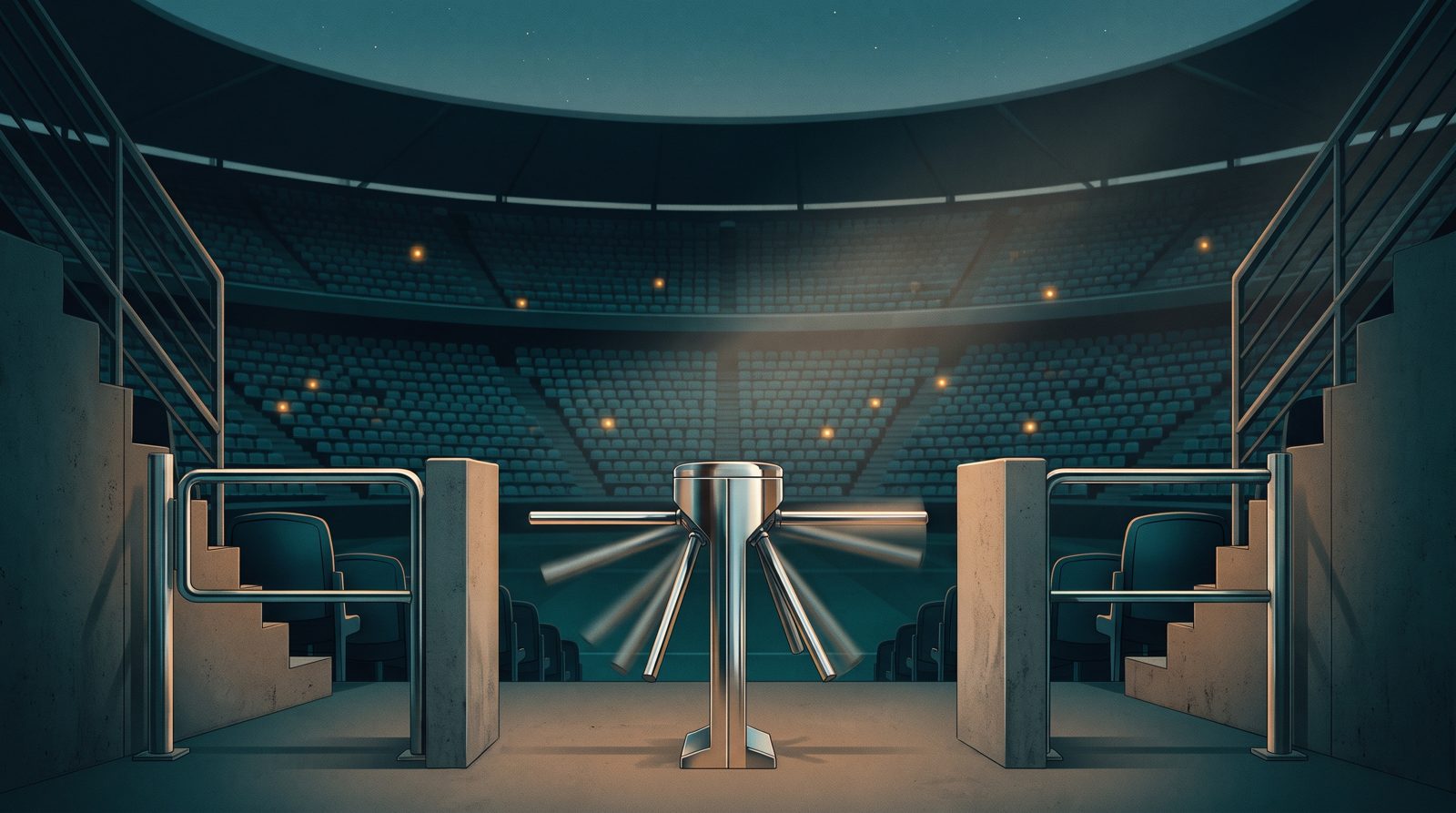
It works a bit like a turnstile at a stadium gate. The turnstile counts entries. It has no idea who stayed in their seat for the halftime show, which is exactly where the sponsor's banner hangs. Every venue builds its own turnstile and sets the tension on its own spring. On August 24, YouTube loosened its spring until a light breeze could turn it.
Look at how differently the springs are set across the industry. Facebook's classic video view, by the company's own description in 2016, was a play that lasted at least three seconds. The ad industry's standard for a viewable video ad, written by the Media Rating Council with the IAB and finalized in its current desktop form in 2015, requires at least half of the ad's pixels on screen for two continuous seconds. YouTube's engaged view counts viewers who keep watching past a threshold the company has never published. YouTube's public view, since August, is the first frame.
Instagram sits close to the loose end of that range. Over 2024 and 2025 it made views the headline number in Insights across Reels, photos, carousels and Stories, and repeat plays count. When Tubefilter explained YouTube's August change, it noted that Shorts had already been counting a view the moment a video loads, the same way TikTok and Instagram Reels do. A viewer who lets a Reel loop five times has added five to the counter.
None of this is hidden. The problem is that the number on the screen travels much further than its definition does. A brand's media planner looking at a screenshot of a Reel with, say, 400,000 views sees a figure. They do not see the spring tension. And a sponsor's message, as Tubefilter pointed out when YouTube made its change, often sits minutes into a video, long after a first-frame view has already been banked.
A view count tells you how many times the turnstile turned. It cannot tell you who was in the seats when the sponsor came on.
The report that put a number on the distrust
The IAB is not a creator advocacy group. It is the trade body that writes many of the technical standards the online ad business runs on, and its members include major media and tech companies. That is what makes the November 10 report notable: it reads like an industry admitting, in public, that many of the people paying for creator work are not confident in what they are buying.
The research came from two waves of work by the IAB's Creator Economy Board and the research firm FrontRow, including a survey of 53 industry leaders that Videomaker reports was fielded between July and September. The IAB itself calls the findings "directional." Within that limit, the pattern is stark. Sixty-seven percent named measurement as the top problem. Every measurement provider in the sample named a common view definition as a top priority. Usage rights were the most common source of contract friction, at 61 percent, and two-thirds wanted standard terms and conditions for creator deals.
The sharpest finding is the confidence gap. According to Videomaker's account of the report, 67 percent of platform respondents said they were very confident in their own numbers, as did 56 percent of creator marketing agencies. Among brands and talent representatives, the share was zero. The people producing the numbers believe them. The people buying with them, and the people representing the talent, are not so sure.
The money at stake is not small. The IAB puts creator media budgets at an expected $44 billion in 2026, up from $13.9 billion in 2021. "Creator marketing has largely won the argument about whether it belongs in the marketing plan," said James Douglas, the IAB's vice president for its Experience Center. "What it needs now is the infrastructure to scale." David Cohen, the IAB's chief executive, put a clock on it: "If we wait, the same friction points will get set in stone and undoubtedly inhibit future growth."
The plan is modest in its promises. The IAB says it will work alongside the Media Rating Council and other industry bodies to bring platforms and measurement providers together on shared definitions of views, impressions, reach and watch time, with that work prioritized in 2027. Tubefilter and Videomaker both report that the IAB hopes to secure agreements from one or two platforms within the first year. No platform has publicly signed on. And the release is careful to say what the effort is not: "The aim is not to standardize creators or set prices."
The turn: YouTube already pays with a different number
Go back to YouTube's own wording, because it settles more than the coverage has noticed. YouTube described the first-frame change as a way to give creators a clearer picture of their exposure for brand partners. It also kept engaged views and engaged watch hours as the basis for what it pays creators through the Partner Program. Engaged views still live in YouTube Studio, where the company calls them the original view metric.
Read those two decisions together and they say something the industry has been politely stepping around. The platform that owns both counters chose the stricter one for its own money and the looser one for the number creators show to advertisers. That is not a scandal. Plenty of businesses keep a public metric and a private one. But it does mean the question the IAB is asking, "which definition of a view should we all use," has already been answered inside the platform, at least for the money that leaves its own bank account.
So who benefits from keeping the public number soft? The honest answer is uncomfortable for creators. A generous counter makes everyone's reach look bigger, and that helps sellers more than buyers. YouTube framed its change as a help to creators negotiating brand deals. Agentio's data suggests the help is not spread evenly. In its analysis of more than 75,000 videos, public views overstated engaged views by 85 percent for micro channels, those averaging under 50,000 views per video, and by 49 percent for channels averaging more than 300,000. Agentio's earlier, modeled estimate from August pointed the same way, with the gap widest for the smallest channels.
If the IAB gets what it is asking for and the industry prices creator deals on something close to an engaged view, the numbers that shrink the most, if Agentio's pattern holds, will belong to the smallest creators. That is the part of the story nobody seems to be questioning. A shared definition sounds like neutral plumbing. In practice it decides who absorbs the gap between the turnstile and the seats. To the extent brands buy on public views today, that gap works in creators' favor.
On YouTube, the public view is the number you are encouraged to sell with. The engaged view is the number you are paid with. That tells you which one the platform believes.
Inside the 219 million
Agentio did not set out to write the IAB's report for it, but its two studies are the closest thing the industry has to a field test of what a definition change does to real channels, so they are worth reading carefully.
The first, published on August 21, three days before the switch, was a forecast. Agentio looked at 35,800 long-form videos published in June and July by creators connected to its platform, and used YouTube's audience retention data to estimate how many viewers made it past the 30-second mark the industry assumed was the old threshold. Its median estimate was that public views would run about 30 percent above engaged views. It also showed how sensitive that guess was: at a 25-second threshold the gap fell to 24 percent, and at 20 seconds to 17 percent. For Shorts, where YouTube already reported both numbers, the measured gap across 550 organic Shorts was 65 percent.
The second study, a week after the change, replaced the forecast with a count. Across more than 75,000 videos published since June 1, Agentio found 549 million public views and 330 million engaged views. That is an engaged view rate of 60 percent, or 1.67 public views for every engaged one. A brand buying on public views, Agentio argued, is likely overpaying by 67 percent: a $30 cost per thousand views on the public number works out to about $50 per thousand engaged views.
The most revealing detail is where the gap came from. Views from what Agentio grouped as browse surfaces (the Home tab, "Up next" autoplay and recommended shelves) made up 38 percent of public views, but only 20 percent of them became engaged views. Those surfaces accounted for 77 percent of the entire gap. Views from people who clicked straight onto a watch page converted to engaged views 85 percent of the time. Category mattered too. Education held the highest engaged view rate, at 63 percent, and technology the lowest, at 46 percent.
Put plainly, the counter is most generous exactly where the viewer made the fewest choices. Autoplay turns the turnstile without anyone deciding to walk through it. That is worth sitting with if you create for Instagram, where the Reels feed is built almost entirely out of videos that start playing the moment they appear on screen, many of them picked by Meta's recommendation systems rather than chosen by the viewer.
The caveats are real and should travel with every one of these numbers. Agentio sells creator sponsorships priced on engaged views, so it has a commercial interest in brands distrusting public views. Its creators are a self-selected group that skews toward professional, long-form channels. Engaged views are visible only to channel owners and permissioned partners, so outsiders cannot check the totals. The $30 and $50 figures are an illustration, not a measured campaign. We could not find an independent, large-sample study that tests the same question, which is itself part of the problem the IAB describes.
Pocket glossary: seven numbers that get sold as reach
- Public view (YouTube, since August 24, 2026). Counted when a video begins to play, from the first frame, on Shorts, long-form and live alike.
- Engaged view (YouTube). A viewer who chooses to keep watching past an unpublished threshold. Still the basis for Partner Program earnings.
- View (Instagram). The headline Insights metric across Reels, photos, carousels and Stories. Repeat plays count, and Reels count from the start of play.
- Three-second view (Facebook's classic definition). The bar Facebook described in 2016, when it explained an error in a related metric.
- Viewable video impression (MRC and IAB). At least half the ad's pixels on screen for two continuous seconds. The ad industry's own floor.
- Impression and reach. An impression counts each time content is shown. Reach counts the unique accounts that saw it. One person can create many impressions and many views, but only one unit of reach.
- Clip view (X, since November 2026). Views on a clip of someone else's video, credited toward earnings for both the clipper and the original creator when both are enrolled in X's creator rewards.
We have been here before
If the idea of a platform-defined metric drifting away from reality sounds familiar, it should. In September 2016, Facebook disclosed that for about two years it had overstated a video metric it showed advertisers, the average duration of video viewed. The company's own explanation was that the figure should have divided total watch time by everyone who played a video, but instead divided it only by "views," which Facebook defined as plays of three seconds or more. The short plays simply vanished from the denominator. The Wall Street Journal reported the overstatement at 60 to 80 percent.
The story did not end there. In October 2018, an amended complaint in an advertisers' class action was unsealed in federal court in Northern California. As CBS News reported at the time, the plaintiffs alleged that Facebook's internal records showed the error was "far from an honest mistake" and that the metric had been inflated by 150 to 900 percent. Facebook called the lawsuit without merit. The case was settled in 2019; Tubefilter, revisiting it this August as context for YouTube's change, put the payment at $40 million. Many journalists and analysts have since concluded that the "pivot to video" a lot of publishers made in those years was built partly on numbers nobody outside Facebook could check.
The other precedent is the viewability standard in display and video advertising, the MRC guideline quoted above. Under it, a display ad counts as viewable when half of it is on screen for one continuous second, and a video ad when half of it is on screen for two. Half an ad for a single second is a modest bar, and that is the lesson worth carrying into the IAB's new effort. A measurement standard does not make an ad more watched. It makes it comparable.
That distinction matters for creators. A common definition of a view would make a Reel comparable with a Short and a TikTok. It would not, on its own, tell anyone whether the people counted actually heard the sponsor's name.
Instagram's place in the counting war
Instagram is not the focus of the IAB report, and the report does not single out any platform's method. But Instagram creators have more exposure to this fight than most, for a simple reason: they already live under a counter that starts at the first play, and the platform has spent the last two years making that counter the center of how creators read their own performance. By the summer of 2025, Social Media Today reported, the views metric was replacing the old "Accounts reached" graph in Insights.
That makes views the number many Instagram creators lead with in a media kit, and a number brands routinely ask for in influencer marketing negotiations. It is also, by the logic of Agentio's browse-surface finding, the kind of number most exposed to a stricter definition, because so much Instagram viewing happens in a feed that plays videos before anyone decides to watch them.
Instagram is also about to stretch the word further. Since October 26 it has been testing Features, horizontal videos of up to 90 minutes, with a small group of US creators, and Business Insider reported that some YouTubers were offered between $50,000 and $500,000 to post there. We looked at those long-form checks earlier this month. Under the current vocabulary, a 90-minute film and a seven-second Reel can both produce "a view." Whatever Instagram eventually uses to sell or pay for long-form, the gap between a play and a watch is likely to be far wider there than on any Reel.
The rest of this month's news shows how quickly the surfaces that generate views are multiplying. On November 9, X launched native clipping: viewers can cut a segment of 5 to 60 seconds from a video of two minutes or longer, and, as Social Media Today and Tubefilter both reported, both the clipper and the original creator are credited with the clip's impressions for X's creator rewards, if both are enrolled. The same eyeballs, in other words, now count twice. Creators cannot currently opt out, though X says it is working on a setting. On November 13, at TwitchCon in San Diego, Twitch said it would extend clips from 60 seconds to five minutes; since October, it has also let partner companies promote stream recaps on Instagram and YouTube. And in a post that Social Media Today reported on November 15, LinkedIn's chief product officer, Hari Srinivasan, said that new comment classifiers had produced "a >20% reduction in views of slop comments" in testing. Even comments now have view counts worth managing.
Each of these is a reasonable product decision on its own. Together they describe an industry printing more of its currency every quarter, while the IAB is still trying to agree on what the currency is backed by.
The numbers, and what they cannot carry
The figures in this story come from different organizations measuring different things, and they should not be stacked on top of each other.
The IAB's findings rest on 53 respondents. PPC Land, working through the arithmetic, noted that if all 53 answered a given question, 66 percent is about 35 people. That is enough to show where senior people in the business feel friction, which is what the IAB says it set out to do. It is not enough to estimate how much money is being misallocated, and the IAB does not claim it is.
Agentio's numbers are larger but narrower. They come from one company's creators, on one platform, over a short window after a definition change, and the company itself expects the gap to move around over time. They say nothing directly about Instagram, which does not publish a split between its views and a stricter engaged count the way YouTube Studio does. Anyone who tells you Instagram's views are inflated by a specific percentage is guessing, because the data to check it is not public.
The $44 billion budget figure is the IAB's own projection for 2026. It describes how much money is flowing toward creators, not how well it is spent.
Every number in this fight is real. Almost none of them measure the same thing, which is the whole point of the fight.
What we know, and what we don't
We know that YouTube now runs a first-frame public view and a stricter engaged view, and that it pays creators on the second. We know the IAB has made a common view definition its first measurement priority, that it is working with the MRC, and that no platform has publicly committed. We know that in Agentio's YouTube data, browse surfaces such as autoplay, and small channels, showed the widest gaps.
We do not know what a standard view will look like, whether it will be closer to a first frame, two seconds or 30, or whether any platform will adopt it for public counters rather than just for paid reporting. We do not know how Instagram will define views for 90-minute Features, or whether it will introduce anything like an engaged view. And we do not know whether brands, once they have a stricter number, will actually pay less per view or simply pay the same amount for fewer, better-defined views. The IAB is explicit that it is not setting prices, so that part will be decided deal by deal.
How Instagram creators can get ahead of the standard
None of this requires waiting for a working group. A creator who reports attention honestly today will look better, not worse, when buyers start asking harder questions.
- Report two numbers, never one. Put views next to an attention figure in every media kit and campaign report: average watch time for Reels, and the share of viewers who reached the point where the sponsor appears. Instagram's Insights already show watch time beside views. Label each number with what it measures, in plain words.
- Write the definition into the contract. If a deal includes a view guarantee or a bonus, name the metric, the source screen and the date range. The IAB found usage rights were the most common source of contract friction, and two-thirds of respondents wanted standard terms. A sentence that says "views as reported in Instagram Insights, captured 7 days after posting" prevents most of the arguments later.
- Move the sponsor to where the attention is. The first seconds are where a feed viewer decides to stay or swipe, and where a first-frame counter records them either way. A mention placed in the opening seconds of a Reel reaches far more of the people the counter recorded than one placed at the end.
- Sell the signals the platform itself ranks on. In January 2025, Adam Mosseri named watch time, likes and sends as the three signals that matter most for ranking, with likes weighing a little more among followers and sends a little more for recommended reach. Those are the same signals a careful buyer should want. Sends per reach and likes per reach are harder to inflate than a view count, and so are saves on Reels, because each one needs a person to act.
- Show outcomes, not just exposure. Follows from a post, profile visits, link taps and promo code redemptions are numbers a brand can match against its own sales. They also make the case for longer deals, and for equity instead of fees if that is where your negotiations are heading.
- Never pad the counter. Bought views and bought followers were always a bad idea. In a market moving toward stricter definitions, they become a liability, because the gap between a padded public number and your real attention figures is exactly what a careful buyer will now look for. The durable path is still real followers who actually watch.
- Get in the room. The IAB says it is inviting creators, talent representatives and others into its working groups and is building a creator advisory body. If you have data on your own attention metrics, that is where it will carry the most weight.
Sell the seats, not the gate
The instinct after a report like this is to wait for the standard and then adjust. That gets the order wrong. The IAB has put the work on its 2027 roadmap, the result may set a modest bar, and it may never touch the counter under your Reels. What has already changed is the buyer. When not one brand in an industry survey says it is very confident in the numbers it is given, the creators who win are the ones who stop leading with the number nobody trusts.
For years the view count has worked like a stadium boasting about how many times its turnstiles turned. It is a real number, and it is not nothing. But the sponsor's banner hangs over the seats, and at least one of the biggest platforms has already shown, by what it pays with, that it knows the difference. The creators who will do best in the next phase are the ones who can show, plainly and with evidence, who stayed for the show. Everyone else will find out what their audience is worth when someone else's definition does the counting.
FAQ
What counts as a view on Instagram?
Instagram counts views across Reels, photos, carousels and Stories, and repeat plays count. For Reels, a view registers when the video starts playing, the same way YouTube Shorts and TikTok count, so views on their own do not show how long anyone watched. Watch time and average watch time, shown next to views in Insights, are what tell you that.
What did YouTube change in August 2026?
From August 24, 2026, YouTube counts a public view the moment any video begins to play, including long-form and live. Before that, long-form views required an unpublished amount of watching. Creator earnings still run on engaged views and engaged watch hours, which YouTube Studio shows separately.
What is the IAB doing about views?
Its November 10 report found a common definition of a view was the most requested standard. The IAB plans working groups with the Media Rating Council on shared definitions of views, impressions, reach and watch time, prioritized for 2027, and hopes to sign one or two platforms within a year. No platform has publicly agreed yet.
Will a standard view lower what creators get paid?
Nobody can say yet, and the IAB says it is not setting prices. If brands start buying on a stricter view, Agentio's YouTube data suggests the biggest drops would come where the gaps are widest today: autoplay views and small channels. Creators who already report attention and outcomes alongside views are the least exposed.